
Stainless Steel Jewelry: Materials and Finishing Options
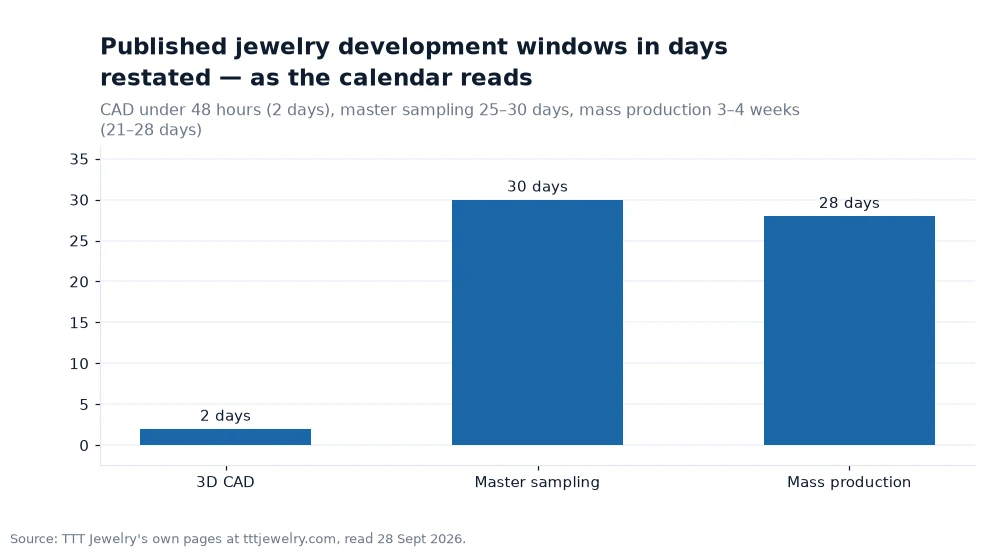
A quotation is only as firm as the specification behind it. Three base materials, four precious-metal finishes, two stainless grades and six customisation options decide what a piece costs and how long it takes, and the published figures put development at 2 days of CAD, 25–35 days of sampling and 3–4 weeks of production. Naming those fields early is what stops a quote from being a placeholder.

Key takeaways
- Base materials: stainless work, artisan brass with recycled content and 925 sterling silver, in 316L or 304 grade.
- Finish options are 14K/18K/24K gold with plus rhodium, protected by anti-tarnish e-coating on silver and brass and PVD on stainless steel.
- Minimums are 50 pcs per design in silver, 100 in brass and 100–150 pcs by style in stainless steel.
- Development runs 2 days of CAD, a 25–35 day custom sample and a 3–4 week production block.
The three base materials and what each one decides
Material choice drives everything downstream: the tooling, the minimum, the finishing route and the retail price the piece can carry. 316L stainless steel, sterling silver at 925 and eco-brass is formed and machined rather than cast, holds its own against water, and starts at 100–150 pcs by style.
The order of those minimums is not a ranking of quality. It reflects how much setup each metal needs before the first sellable unit exists. Silver is quick to tool, brass needs a plating stack to look like anything, and steel is the hardest of the three to form and finish — which is why the steel minimum sits highest and why the stainless line publishes its own figure rather than borrowing the others.
Two stainless grades, two tiers
The stainless page separates 316L from 304, and the difference is a specification decision rather than a quality shortcut. 316L contains 2–3% molybdenum, is published as 100% waterproof — shower-safe, sweatproof, swim-proof — is medical-grade hypoallergenic, and takes PVD with optimal adhesion; it is positioned for high-end designer and waterproof collections. 304 is water-resistant for normal daily wear, nickel and lead safe, and holds reliable commercial vacuum plating, which suits high-volume wholesale, fast fashion and promotional lines.
Both grades sit inside the same low MOQ band of 100–150 pcs by style, so the grade does not change the size of the order. It changes the tier the piece is sold into, which is why the grade belongs on the drawing next to the finish rather than in a later email.
Finishing options and where they apply
| Base material | Published finishing route | Minimum per design |
|---|---|---|
| 925 sterling silver | Multi-layer precious metal plating plus anti-tarnish e-coating; S925 hallmark | 50 pcs |
| Artisan eco-brass | Multi-layer 14K / 18K / 24K gold and rhodium plus anti-tarnish e-coating | 100 pcs |
| Stainless steel (316L) | PVD vacuum plating with optimal adhesion; 316L hallmark | 100–150 pcs by style |
| Stainless steel (304) | Reliable commercial vacuum plating; nickel and lead safe | 100–150 pcs by style |
Finishing is the field buyers most often leave half-specified. The colour question is answered by multi-layer gold — 14K, 18K or 24K — or by rhodium. On steel, the finish arrives through PVD vacuum plating, which means the surface has to be polished correctly first — a step that shows up in the eight-step route as high-gloss polishing and brushed or textured surface art, both of which happen before the coating.
What to settle before the brief goes out
Six customisation options are published: stones set as accents, base materials, plating and finishes, the packaging set, findings and chains and hallmarking and logo. Settle all six before you get a quote, because a quotation built on an unfinished specification is a placeholder that will be revised before the sample is cut.
The mark sits inside those six rather than alongside them. Laser engraving applies a brand logo and a purity hallmark in one pass — S925 for silver, 316L for stainless steel, 18KGP for gold-plated pieces — and the layout is confirmed on the CAD drawing, which returns inside 48 hours. Packaging is the sixth field, and it covers metallic logo tags, foil-stamped gift boxes, pouches, backing cards and barcode labelling, all specified before the final inspection pass rather than after it.
Worked example: working backwards from a delivery date
The published windows are 3D CAD in under 48 hours, a custom sample in 25–35 days, and mass production in 3–4 weeks. Take a launch that needs cartons in nine weeks. Nine weeks is 9 × 7 = 63 days. Subtract 2 days for CAD and 28 days for the long end of production, and 63 − 2 − 28 = 33 days remain for sampling.
Thirty-three days sits inside the 25–35 day window with room to spare, which is the useful part of the calculation: a nine-week plan is achievable if the specification is signed off in the first two days. Compress the target to eight weeks and 56 − 2 − 28 = 26 days remain, barely inside the fast end of the window. The arithmetic is mine; the windows are the published ones, which is why the specification conversation belongs at the start of the project rather than in the middle of it.
Repeat orders and the cost of changing a specification
Once a design is approved, the mould, the CAD file and the finish specification exist, so a reorder runs on the 3–4 week production block without reopening the sample gate. That is where the value of settling the specification early shows up twice: once on the first order, and again on every repeat.
Changing a field afterwards moves the cost. A packaging change is a conversation at the packing bench. A finish change after plating means the piece goes back through the chamber. A material change means new tooling, the relevant minimum, and a fresh route through prototyping. The published 100% NDA keeps the moulds and the collection exclusive to the buyer's brand, which makes those decisions worth getting right the first time rather than testing on a shipped batch.
Frequently asked questions
Which stainless grade should a first order use?
316L if the piece has to be shower-safe, sweatproof and swim-proof, with medical-grade hypoallergenic status; 304 if it is water-resistant daily wear aimed at volume, with nickel and lead safety and reliable commercial vacuum plating.
What is the minimum order for each material?
Entry quantities are 100 plus in the stainless line, 100 in artisan brass and 50 pcs in 925 sterling silver, for each design.
How long does a first order take?
Under 48 hours for 3D CAD, 25–35 days for the custom sample, and 3–4 weeks of production after the sample is approved, plus your own approval time.
Making the specification conversation a short one
Write the six fields down — material, finish, findings, stones, logo and hallmark, packaging — add the grade if the piece is steel, and send the whole list with the sketch. Everything after that is a review of what you specified rather than a round of questions about it. Two pages to keep open while doing it: the OEM and ODM service outline for how a brand-owned file or a co-created concept is handled, and the wholesale page for how minimums and finishing options stack across a collection.
Most of what this piece relies on — the 100–150 piece stainless minimum (by style), followed by the PVD route for stainless steel, the 316L / 304 grade comparison — is set out on the maker's own pages over at tttjewelry.com, checked 28 Sept 2026. The arithmetic in the worked example is mine alone — the site supplies the inputs only[1].